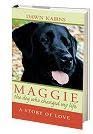
MAGGIE: the dog who changed my life

MAGGIE: the dog who changed my life
Click photo to visit dawnkairns.com
Showing posts with label dogs. Show all posts

Tuesday, November 11, 2014

Please Just Give Me a Sign

Bailey Bear
My friend recently lost her beautiful Golden Retreiver, Bailey Bear (BB), to heart failure. Like so many of us, she was not prepared and it was a devastating loss for her. Again like so many of us when we lose a beloved pet, she experienced guilt. In her case it was concern that she and her husband had left BB alone too much when they went away on trips. Now, mind you, Bailey Bear was taken to a popular, upscale Boulder kennel where she received a lot of attention from people and played with other dogs. But that was where my friend's guilt came in. Was BB happier with all the excitement of being with other dogs and people than spending time at home with Patricia and her husband? Of course we know the answer to that! I had been on hikes with Patricia and Bailey Bear. BB adored my friend.

Soon after BB passed, Patricia was running one day and talking to BB's spirit. She asked BB  if she had been happy with how they cared for her during her lifetime. Patricia  asked her to give her some sort of a sign that she had been happy. She kept looking around for signs as she ran - butterflies, birds, etc. When she got back in her car after her run and while driving home, Patricia continued to talk to BB.

Lola
"Now here comes the WOW part." she told me as she recounted her story to me. "As I was walking into the door of my house Rhonda (BB's caregiver from Cottonwood Kennel) sent me a text with a photo that I thought was BB. A couple of minutes later she sent another text to tell me that the photo she sent was of BB's sister. Her name was Lola and it was the first time she had been to Cottonwood! She did some things that reminded Rhonda of BB, so she looked at her information. Lola had the same birthday as Bailey Bear - Valentine's Day 11 years ago! Rhonda confirmed with the owners when they picked her up that she came from the same breeder. I think BB gave me a sign through Lola."

As though BB wasn't convinced that was enough of a sign, Patricia had a most unusual experience with a wild animal -- a marmot -- right on her front door step. She heard a noise and went to explore. There, standing at her front door looking right in the window and scratching on it as if to want in, was a marmot! That just doesn't happen!

"In the 12 years we've lived here, I have NEVER seen a marmot up here," Patricia told me. "Roman (her husband) saw a marmot one time about 3 years ago."

Marmots don't do this!!
I, too, have had out of the ordinary experiences with wild animals after a loved one has passed. Like the bird who grazed my face with its' wing after my parents' passed. You may call it coincidence. But I can't ignore the serendipity of it all. How about you? Do you have your own stories you'd like to share in the comments below about how your pets or other loved ones who have passed have found a way to make their presence known to you from the other side?

Posted by Dawn Kairns, Author of
MAGGIE the Dog Who Changed My Life

Wednesday, June 4, 2014

Possible Cure for Canine Parvovirus?

My Precious Maggie as a Puppy
According to the AP, a North Dakota company that discovered an antibody technology while trying to cure dying geese is using its research to save puppies. Early tests with Avianax performed on 50 puppies in seven states resulted in a 90 percent cure rate for parvovirus, which kills some puppies while others are often euthanized due to the high cost of treatment.

The U.S. Department of Agriculture issued a conditional permit for the field trials that are taking place in sites in seven states. Visit this ABC news link to learn more and read the full AP article.

If you wish, a click on my book titles below will take you to their order pages:

MAGGIE the Dog Who Changed My Life
FINAL YEARS Stories of Parent Care, Loss and lives Changed

Monday, December 2, 2013

Longmont Humane Society Now and Forever Campaign Reaches Phase 1 Goal

Volunteer Camie Kirkevold works with a cat named Kiki on Wednesday at the Longmont Humane Society. (Matthew Jonas/Times-Call)
According to The Longmont Humane Society they have reached their Phase 1 goal of their "Now and Forever" Campaign.  They avoided foreclosure! They were able to make their November payment of  $772,227.68 "because of the generous support of our friends and donors in Longmont." 

They did it "after cashing in its investments," director Liz Smokowski told the Longmont Times Call. The investments netted $363,118, which combined with $526,932 in donations exceeded the amount needed for this year's payment.


The shelter's Board members have worked diligently to "improve and augment" their operating finances which the Longmont Humane Society has been concerned about for several years. Over the past two years, Longmont Humane Society changed leadership in order to take a new direction and respond to the urgency of their financial situation. As a result, they have raised animal adoption prices, reduced staffing costs and marketing expenditures, increased the number of volunteer positions, and boosted their fundraising efforts. "Longmont Humane Society has achieved a combined positive cash flow from operating and investing activities over the past two years." They say their cash drain "is related to financing of the construction project and the related bond offering that was taken."Without their principal and interest payments, Longmont Humane Society would be wholly sustainable.  

The Longmont Humane Society will still need to raise the final $2.4 million even after this payment. Liz Smokowski, hired in 2011 by the Longmont Humane Society, told the Times Call the shelter is "still seeking donations to cover the payment because cashing in the investments drained all of the its savings." Their operating expenses are now compromised and they have no reserves.

The fundraising campaign is titled, "The Longmont Humane Society: Serving the Community Now and Forever." Focused on the November payment until now, they now seek "to raise $3.1 million to pay off the remaining loan amount by the fall of 2014." Next year's loan payment is also $772,000, so they are far from out of the woods. Phase 2 of their campaign is to raise $2.4 million by the end of 2014.


Monday, November 18, 2013

You and I Together Can Keep Longmont Humane Society From Foreclosing

Longmont Humane Society is still working avoid foreclosure. I wrote about them in a previous post on 8/7/13. They are still looking for donations. And still hopeful.


I so want to help. Do you? Longmont Humane Society is just a few miles up the road from where I live. They help so many animals. Probably like you, what I can contribute alone is limited. With your help, here is what I will do. My new book, FINAL YEARS Stories of Parent Care, Loss and Lives Changed  is on Kindle. Between now and November 29, for each of you who purchases a Kindle copy of FINAL YEARS , I will contribute the full amount of $6.99 per book to Longmont Humane Society. Simply email your receipt from Amazon to me at dawnkairns@yahoo.com. It doesn't sound like much, but it can add up if you choose to participate.

To learn more about the plight of Longmont Humane Society, see the 10/31/13 article in the Times Call newspaper for the full story and for how you can donate directly to the shelter. With only 12 days left, more than $200,000 still needs to be raised. They have raised over $500,000 in the past several months. Please take a moment to watch the 11/17/13video above from 9NEWS.

If you have any quick fundraising ideas for Longmont Humane Society, please share them with me in your comments. Thank you for your help!

Click title below if you want to order my book(s):

Thursday, November 14, 2013

Dog Travels Ten Miles from Adoptive Home to Find Beloved Canine Partner Left Behind

I have known dogs have emotions, don't you? For us and for each other. Those of us who have and love our dogs can't miss it. My dog, Maggie, (MAGGIE the dog who changed my life) was my main teacher on this one, although I think I always knew. They love, hope, can be sad,disappointed, heartbroken, and more. I think only animal researchers have to fool themselves to believe it isn't so.

It began on the streets of Terre Haute, Indiana. Two street dogs, Ben and Jade met and bonded. OK, it seems they fell in love when you hear the whole story, reported both on the Care 2 Blog and in The Tribune Star. They were both known and cared for in their community, but when Jade became pregnant, they were trapped and taken in by the humane society in Terre Haute. Initially kenneled together, the shelter separated them when Jade gave birth. Mom and pups were taken into foster care for eight weeks. All six puppies were adopted. Then Ben and Jade were reunited at the shelter until ... Ben got adopted and Jade didn't. For three weeks Ben was in his adoptive home while Jade remained in the shelter ten miles away. On a cold December day Ben seized his chance when Jason Lawler took on the trash. Ben darted out the door and trekked the ten miles in the cold back to the shelter to find Jade.

It's a touching story with a beautiful ending. I encourage you to read the full story in The Tribune Star and the Care 2 Blog where I first learned how love will find a way with two beautifully bonded dogs. Let's just say that even though the Lawlers were convinced they only wanted one dog, their minds and hearts were changed! Read the full reunion story on one or both of the links I shared above. It brought tears to my eyes. How about you?

Click title below if you want to order my book(s):

Thursday, January 5, 2012

Black Labrador, Maddie in Slow Motion Play (VDO)

Posted By Dawn Kairns, Author of MAGGIE: the dog who changed my life


You may remember Maddie, our adopted 10 month old black lab/lab mix who you may have met at the end of my book, MAGGIE the dog who changed my life. Maddie is now 6 1/2 years old and continues to be vibrant, happy, and healthy. She lights up our lives. This is a slow motion video of her that my husband captured of her yesterday at the dog park playing. I place it here to share with you the joy and the grace of her movement. I love the slow motion that captures every slight move!

Tuesday, October 18, 2011

"Women Who Run With the Wolves"

I am re-posting the introduction to this story by Katie Arnold-Ratliff, associate editor of Oprah Magazine and author of the novel Bright Before Us,with a link to the full story that she wrote in Slate Magazine Friday, October 14, 2011. She talks about how more and more dog memoirs are written by females, and briefly reviews a few of them.

Women Who Run With The Wolves

Jill Abramson’s The Puppy Diaries, Julie Klam’s You Had Me at Woof, and why dog women get more respect than cat ladies.

By Posted Friday, Oct. 14, 2011

Few things these days are as likely to land a book on the nonfiction best-seller lists as a dog—particularly one whose incorrigible mischief, heart-rending rescue, or fraught integration into the author’s life sparks a realization about love, kindness, or What’s Really Important. In the post-Marley and Me publishing landscape, the dog-as-harbinger-of-wisdom grows ever more ubiquitous, and though Marley was written by a man, more and more of the writers who are following his lead seem to be female. The dogs at the center of these books are, in turn, ever more exceptional, the kind of dogs who double as life coaches and inspire titles like these: Maggie: The Dog Who Changed My Life, Blind Hope: An Unwanted Dog and the Woman She Rescued, and Paws and Effect: The Healing Power of Dogs...

Read full story and Katie's additional dog memoir reviews here: http://www.slate.com/articles/double_x/doublex/2011/10/jill_abramson_s_the_puppy_diaries_julie_klam_s_you_had_me_at_woo.html

Thursday, August 4, 2011

Heart to Heart: Nonverbal Communication with Your Animals

Posted By Dawn Kairns, Author of MAGGIE: the dog who changed my life

I was first awakened to animal communication through my relationship with my black lab, Maggie. After her death I had my first introduction to an animal communicator, and was simply amazed at her intuitive/psychic abilities in regards to my relationship with Maggie. I write about my awakening to intuition, animal communication and animal energy in my book, MAGGIE: the dog who changed my life. (If you want to learn more visit www.dawnkairns.com). Since then, my other animals have had the benefit of seeing them through an entirely different filter ... that of looking for their nonverbal communication in a way I didn't know to before. Today I read this article about animal nonverbal communication on the Care 2 Blog and want to share it with you.

Maddie, our 6 year old "black lab," rescued at 10 months

Nonverbal Communication with Our Dogs and Cats

Nonverbal communication is a gift that all living beings share, one you’ll need to reawaken to better interact with and care for your animal companions. Most dog and cat lovers already understand canine and feline body language, which is one non-verbal technique. But you can use your other, natural, nonverbal communication skills, and actually begin to see things through your dog or cat’s eyes, and become his/her voice.

You can learn animal communication by taking a class or reading some of the great books available today on the subject. But many of the basics are so simple that we can easily begin nonverbally communicating right away. Remember, long before humans had spoken language, we were able to communicate among ourselves and with the animals; it is a kind of heart to heart communication skill that we all possess.

Did you ever know a set of twins who said they each knew what the other was thinking, or you heard your mother say she had “woman’s intuition” or “just knew something was wrong.” Have you ever had an image of a friend come to mind and then received a phone call from that very person saying,“I was just thinking about you and wanted to say hello”? These are all examples of nonverbal communication.

Those of us fortunate enough to have been raised with animal companions probably “talked” to them all the time—and they “talked” back—without words. You didn’t have to be Dr. Doolittle to do it, either. You may have chalked up your own memories of such experiences to an overly active imagination. But it’s far more likely that, as a child, you were still unencumbered by belief systems that would tell you otherwise.

You can try it anytime with your own dog or cat, simply by listening to your heart, instead of to your head with its endless, meaningless chatter. Just let those thoughts pass by you, and relax and breathe deeply. You’re going to visualize your furry companion coming over to you. Close your eyes so that you focus on every detail: the feeling of your dog or cats lovely coat, those deep, trusting eyes staring up at you, and imagine him walking toward you. Often, even the first time you try it, your cat or dog will be by your side before you know it, so happy that you’ve communicated with him at long last, in his own way.

Please don’t worry about whether you’re “doing it right.” Not every person (or animal) is visually oriented. Visualization is just like imagining or remembering. It may come as actual pictures, like a movie, or as sounds, or a voice, or as feelings, or just a sense of “knowing.” Any way you receive the information is valid.

It is very important to always communicate in positive terms— “see” what you want your dog or cat to do, rather than focusing on unwanted behaviors. Dogs and cats live fully in the moment, so picture them as you want them to be. For instance, don’t ask them if they want to go to the vet or the groomer or for a ride in the car. Why? Because, they don’t know how they’ll feel until they get there to that exact moment in time. Unlike us, dogs and cats live in the moment. What lessons we can learn about being here—right now! So visualize them peacefully riding in the car, or calmly allowing the vet to examine them.

Practice visualizing positive, loving pictures rather than negative, worrying ones. Have you noticed that the things you worry about often seem to happen? Practice positivity, and positive visualization, and you’ll find it spilling over into every aspect of your life.

This is so crucial when communicating with your animal companions. If you say, for example (either out loud or nonverbally), “Don’t jump on the couch,” your dog or cat sees an image in your mind’s eye of him jumping on the couch. He won’t get the “don’t” part of it. He’ll think oh, she wants me to jump on the couch. Your yelling at him to not jump on the couch is then a mixed signal. Instead, say and visualize what you DO want him to do. In this case, you would say, in an even but stern tone, “Go to your bed!” Then gently carry or lead him to his bed to reinforce the positive behavior.

It’s impossible to hide your feelings from dogs and cats. They always know—and they may “get it” even before we know ourselves. They can even take on your stresses, fears, and frustrations. Over time, these may manifest as illness. So it’s a good idea to even refrain from arguing in front of your animal companions; it’s extremely stressful for them. It’s not fair to treat them as if they’re not in the room when we lose control of our emotions. Their sensibilities should be respected.

To give you an idea how sensitive dogs are, Rupert Sheldrake, a British biologist and the author of Dogs That Know When Their Owners are Coming Home, did an experiment in which he placed video cameras with time codes in the house, aimed to catch the action of the homebound dog. At a random time, unbeknownst to the human or dog, the human would get a phone call on a cell phone many miles away, saying to return home. At that very instant, cameras showed that the homebound dog would become excited and run to the door to wait for their human. This experiment was repeated hundreds of times, and were all confirmed by the videos. The moral of this story: don’t feel silly practicing nonverbal communication, EVER!

You can also practice this pure heart-to-heart communication skill with a new pet, or with animals at dog or cat shows or shelters, or even at your vets office. First, learn the cat or dog’s name, if possible. Try saying the name in a sweet, soft, “feminine” (high-pitched) voice. We pretty much all do that with animals and babies, right? It seems, in the animal world the female voice is the most nonthreatening. If you’re a man, or a woman with a deep voice, raise your pitch and speak softly.

Of course, always ask the guardian if it’s okay to work with and touch the animal; and then ask the animal’s permission.

To start, if you can, get down a bit lower than normal (ideally, at the animal’s eye level) and imagine the dog or cat sitting on the floor of your own home. You may get a response as a picture of what his own home looks like from his point of view. Perhaps you can distinguish the outlines of a bed or the legs of a coffee table from underneath: what the dog sees from that perspective. Your image may look like a black-and-white negative, reverse image, rather than a normal photo type memory.

If you don’t get a picture, it doesn’t mean you’re not doing it right. The dog may just be telling you he’s not allowed in that room. Trust yourself and the feelings that come up and continue to listen with your heart. Accept the images or feelings you do get, and go on. He may tell you something about what he likes or dislikes. Or he may be content exactly where he is right now. Keep going anyway, and just let him talk through his own senses.

What are you getting? Is he showing you what his floors look or feel like? Do cold, slippery floors make him nervous because he skids on them? Now visualize the cat or dog’s feeding area. What kind of food does he eat? Do you taste or feel any textures in your mouth? What about water? Is it fresh and clean? What has he smelled recently? He may change the picture you send to reflect his truth, and he may present it to all of your senses or just some of them.

As you continue, do see other animals where he lives? Send him a picture of one of your animal companions. What does he say to that? What does he like to play with? Cats may have little balls and catnip toys, and dogs may have chew toys, tennis balls, or maybe even a Frisbee. Give him these images and see what you get back. If his human companion is there, ask questions to help you assess your images. After you present an image to him, remember to leave a space for him to answer.

As you read the impressions your animal friend is sending. You may receive feelings of space and expansion if he has room to play and places to rest in—or feelings of contraction if he’s been caged or otherwise too restricted.

Perhaps you may feel he’s trying to tell you about an aggressive person. This person may not necessarily be a man; it could be a woman or child with a strong personality—dogs and cats sense human beings as personalities, not as men and women. Ask the dog or cat non verbally how he likes this person. He may wish the person would leave him alone, or he may enjoy playing with the person but can’t understand why he gets scolded for playing too roughly.
  
You can use your nonverbal skills to assess the animal’s well-being through a mental body scan. Just look at the animal, starting with the head and working down the back to the tip of the tail. How do you feel compared with how you felt before scanning? If you feel anything unusual as you continue your scan, you may be on to something. Ask the dog or cat, using his name, how he feels as you move along his body with your eyes.

If you don’t have permission to touch the animal, you can pet the cat or dog’s aura. This is more subtle, but just as effective. Think how you’d feel if a perfect stranger just started stroking you without your consent. Then when you use this indirect way of laying on hands by petting the space around the body (which is referred to as the etheric double), you can often feel the animal’s energy and determine whether he is receptive to your touch, which after all will leave your scent on this dog or cat. By using the etheric double area you will find that this in itself is a valuable avenue of communication and diagnosis, and through it you can offer much healing, especially when you use love as the catalyst.

As you practice, your skills will improve. When doing a mental body scan, you may feel discomfort in certain parts of your own body. While this is important information, you do not need to hold it in your body. Simply release the feeling and say to yourself,“This animal’s feelings are his own. I release them.” In your mind’s eye, wrap the dog or cat in healing white light, or say a prayer or blessing. Then “turn off” the discomfort, much as you would the TV when it transmits images you don’t like. As simply as you would change the channel; just change the subject. It is never necessary to be the recipient of any other being’s pain.

Nonverbal communication seems to come most easily with other people’s animals. It’s sometimes difficult to practice with our own furry friends because we are so emotionally involved with them. Gradually you’ll develop a proficiency that you can then apply at home. Most folks do their best communicating with their own animal companions through play. Through play we express and hear verbal, non-verbal, body language, and other communications.

Be sure to talk to your animal companions about their day. Sometimes if you have more than one then they compete to communicate with us all at once. Just give them the time and the space to get it all off their chests. Remember, they knew you were coming home long before you got there as Sheldrake proved, and have been happily waiting to talk to you!

Nonverbal communication can greatly expand your relationship with animals, but some dogs and cats are reserved, just like certain people are. They simply don’t want to converse. Don’t be discouraged. And some people never get pictures, only feelings; and that’s fine. Trust yourself, and proceed with openness, imagination and confidence. You’re on your way to being a nonverbal communications expert and experience for yourself that the intelligence and spirit in all life!

Wednesday, March 16, 2011

L.A. Passes Puppy Mill Law

Posted By Dawn Kairns, Author of  MAGGIE the dog who changed my life A Story of Love 

(Original Post on Care 2 blog, "Breaking News: L.A. Passes Puppy Mill Law" by Sharon Seltzer)

It looks like Los Angeles County didn’t want to wait for a national or statewide puppy mill law to go into effect.  On Tuesday the Board of Supervisors passed an ordinance to protect animals raised by breeders or kept in pet stores.

According to Daily News Wire Services, the law was introduced by Supervisor Michael Antonovich, “an animal lover who presents a dog or cat for adoption at virtually every board meeting he attends.”

The ordinance is an amendment to Title 10 – the code relating to the licensing of animals and animal facilities, and the care and breeding of animals.

The new ordinance will require breeders to:
  • Only breed dogs that are at least 12 months old.
  • Keep puppies in their possession until they are at least 8 weeks old.
  • Place pregnant dogs in separate living quarters at least three days before they give birth.
  • Provide nesting boxes for mother dogs and their puppies.
The new rules also make sure all puppies are microchipped or tattooed when they turn four months old.  

And pet shops will be required to inform potential pet owners where the puppies in their store come from.

The Board of Supervisors apparently had some disagreements about limiting the number of dogs a breeder could own, so they came up with this compromise.

Breeders will be limited to housing 50 unspayed or unneutered dogs unless they can prove to county officials they can properly care for more.

Those breeders will be mandated to keep stricter medical records, have staff at the facility 18 hours a day and be subject to more frequent inspections, at their own cost.

Title 10 currently requires breeders to provide “structurally sound” housing that is clean and sanitary, enclosures with solid bottoms, wholesome food, accessible clean water and proper grooming for the dogs. 

It also states no animal shall be left unattended for more than 12 consecutive hours, requires veterinary care, humane treatment and exercise.

Even with the amendments L.A.’s Title 10 is far from perfect. However it covers most of the same regulations as Missouri’s Proposition B that was passed by the voters last November. 

That law is being hacked apart by legislators and breeder associations’ who complain how its restrictions will inhibit their livelihood.

Thursday, March 10, 2011

Toxic Tick and Flea Products Affect Pets and Humans

Posted By Dawn Kairns, Author of  MAGGIE the dog who changed my life A Story of Love
original post by Delia Quigley on the Care 2 Blog on Mar 9, 2011

I thought this post by Delia Quigley was worth a re-post for you, your Dogs and Cats!

The snow has not completely melted and the ticks are already making a play for Maya and Seamus. Looking back a year ago, as a new dog owner, I was instructed to buy a certain chemical product to apply to my pups, which would literally have the ticks and fleas falling dead to the floor. This, I thought to myself, is too good to be true; but because I was ignorant and advised by those I considered more knowledgeable, I bought a rather expensive 3-months supply of Frontline with the anticipation of a tick-free summer ahead. As I read the package instructions I was shocked to find that the chemical ingredients were so toxic they must be applied with latex gloves so as not to, as in never, touch my skin.

Yes, but what of my pups skin? If it is toxic to me, what must it be to their small bodies? You might think that I tossed the whole thing in the garbage on that realization, but no, I am ashamed to say that I did not. For two months I applied the toxic chemicals until one day I did my own research. What I found is shocking, perverted, untenable, and horrifying, but we Americans keep on poisoning our pets, along with ourselves and chemical companies continue to provide the loaded gun.

The active ingredient in Frontline is fipronil, an insecticide and member of the phenylpyrazole family of chemicals. Its purpose is to disrupt an insect’s nervous system functions. Well, hold on there doggie, according to the Journal of Pesticide Reform, “In tests with laboratory animals, fipronil caused aggressive behavior, damaged kidneys, and ‘drastic alterations in thyroid function.’ The fipronil-containing product Frontline caused changes in the levels of sex hormones.”

The other two toxic bad boys in Frontline are Methoprene, a neurotoxin that can cause liver enlargements, headaches, throat irritation and nausea and Ethanol, which can cause fatigue, lethargy, dizziness and nervous system disruption.

In her excellent 2008 Care2 article, The Surprising Poisons in Our Pets, Melissa Breyer reports that according to the Texas A&M Veterinary Medical Center, “dogs have much higher rates of cancer than people do, including 35 times more skin cancer, four times more breast tumors, eight times more bone cancer, and twice the incidence of leukemia.”

And here’s the kicker, the Environmental Protection Agency has classified fibronil as a carcinogen, because exposure to fipronil caused benign and malignant thyroid tumors in laboratory animals. All of which means it can cause cancer in both animals and humans.

You can be exposed to fibronil by petting an animal that has been treated with Frontline. The treatment persists for at least 56 days on pets. The good news is that the National Resources Defense Council (NRDC) has checked over a hundred tick and flea products finding that most of them contain chemicals toxic enough to cause harm to both pets and humans.  You should refer to their list before buying a product that may potentially harm your pet and contaminate yourself and your children. Fortunately, there are plenty of natural ways to control ticks and fleas in your environment. Care2 has a number of articles to help you out. Click HERE for a list of natural flea and tick control remedies.
Monday, October 18, 2010

Do Our Animals Who Pass Visit Us from The Other Side?

My wonderful feline girl, Cinnamon, did not have some of the usual fears and aversions you'd expect from cats. For example, when it snowed, she couldn't wait to go outside and tromp through it, or sit under a chair outside and look around for where she wanted to trudge next. As opposed to my previous kitty, Shanna, who merely had to see snow through the window inside to begin shaking her foot as though it was already wet!

Gone from this physical world, but STILL a presence ...
In Cinnamon's later years, when I stood in front of the mirror in the bathroom ready to dry my hair, Cinnamon came in and lay against the back of my legs. I cherished the feel of her soft fur against me. I got my hair dryer out and explained to her I was about to turn it on and she probably wouldn't like it. Then I held it down to her so she could sniff it and know what I was about to do. She was not phased. I would shrug in a bit of disbelief, and turn it on. Maybe Cinnamon would get up and saunter a couple feet away to sit in the doorway and watch me. And maybe she'd stay put right there, against my legs, letting me continue to relish her closeness, her softness; not in the least bit rattled. I came to love these moments with her. Maddie, our black lab, lay a safe distance away in our bedroom, resting or sleeping, with no hint of coming into the bathroom.

So it was no surprise how much I missed it when she Cinnamon got sick, began her decline, and stopped our special bathroom moments. When she passed on August 26, 2010, I knew these treasured times were gone forever.

"Black dogs will ALWAYS be my favorite!"

A couple of weeks later, I pulled out my hair dryer after my shower and stood as always in front of the bathroom mirror to dry my hair. In walked Maddie. Now you have to understand that Maddie steers clear of the bathroom during and after my shower (as opposed to Maggie, who I also had magical connecting moments with in the bathroom prior to my shower). I think it's too warm for her. So imagine my surprise when Maddie walked in, with a bit of a peculiar look on her face, and took small steps to curl into a ball against the back of my legs, EXACTLY as Cinnamon had done!! I was in utter amazement, and my tears began to flow. I could feel my Cinnamon speaking to me through Maddie. Maddie never did this before, and has not done it since (although she did walk in with a bit of a sheepish look the other night, brush against me, and walk out as I dried my hair).

What do you think? Have you had experiences like this with your animals? Do you brush it off or shrug it off to coincidence? Or do you look for those communications with your loved ones from the other side and validate them?

Posted by: 

Dawn Kairns
Author of
MAGGIE the dog who changed my life A Story of Love

https://blogger.googleusercontent.com/img/b/R29vZ2xl/AVvXsEhkMvEcr1rSrSWb96YsGoOOPvq98JXC1i6obm7q74N_t16VtUgTPPNCk6WgYqrLprxsGyWxMgsVqHTYN6L3nLVMZaKt-kc9mZIrqAgVkWUzfQ4US29wHMgZ2-OewnzTexhG9dj9-BfGg3I/s640/smaller+tilted+bookcover+from+paint.jpg
Website: www.dawnkairns.com
"They stay in our lives for a while, leave footprints on our hearts, and we are never, ever the same." -- Author Unknown
Become a fan on Facebook of MAGGIE: the dog who changed my life

2009 Indie Book Awards Finalist
DWAA 2008 Merial Human-Animal Bond Award Finalist