 | ||
| By: Tully NewsInfo Please do what you can to help these precious ones ... Posted By Dawn Kairns, Author of MAGGIE: the dog who changed my life |
MAGGIE: the dog who changed my life
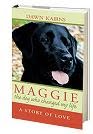
Click photo to visit dawnkairns.com
Sunday, October 23, 2011
In Honor of all the Homeless Animals

Wednesday, October 19, 2011
'You've Got to Find What You Love'
Posted By Dawn Kairns, Author of MAGGIE: the dog who changed my life
In Honor of Steve JobsWhen I heard just a portion of Steve Jobs 2005Commencement address to Stanford University, I knew I would search for the entire address online as it was so inspiring. It epitomizes following your heart and intuition. The next day, I received his entire address in an email from a friend. I love it when thought manifests so quickly. Steve Jobs, you will be missed ...
Stanford Report, June 14, 2005 'You've got to find what you love,' Jobs says.
(This is a prepared text of the Commencement address delivered by Steve Jobs, CEO of Apple Computer and of Pixar Animation Studios, on June 12, 2005).
"I am honored to be with you today at your commencement from one of the finest universities in the world. I never graduated from college. Truth be told, this is the closest I've ever gotten to a college graduation. Today I want to tell you three stories from my life. That's it. No big deal. Just three stories.
The first story is about connecting the dots.
I dropped out of Reed College after the first 6 months, but then stayed around as a drop-in for another 18 months or so before I really quit. So why did I drop out?
It started before I was born. My biological mother was a young, unwed college graduate student, and she decided to put me up for adoption. She felt very strongly that I should be adopted by college graduates, so everything was all set for me to be adopted at birth by a lawyer and his wife. Except that when I popped out they decided at the last minute that they really wanted a girl. So my parents, who were on a waiting list, got a call in the middle of the night asking: "We have an unexpected baby boy; do you want him?" They said: "Of course." My biological mother later found out that my mother had never graduated from college and that my father had never graduated from high school. She refused to sign the final adoption papers. She only relented a few months later when my parents promised that I would someday go to college.
And 17 years later I did go to college. But I naively chose a college that was almost as expensive as Stanford, and all of my working-class parents' savings were being spent on my college tuition. After six
months, I couldn't see the value in it. I had no idea what I wanted to do with my life and no idea how college was going to help me figure it out. And here I was spending all of the money my parents had saved their entire life. So I decided to drop out and trust that it would all work out OK. It was pretty scary at the time, but looking back it was one of the best decisions I ever made. The minute I dropped out I could stop taking the required classes that didn't interest me, and begin dropping in on the ones that looked interesting. It wasn't all romantic. I didn't have a dorm room, so I slept on the floor in friends' rooms, I returned coke bottles for the 5¢ deposits to buy food with, and I would walk the 7 miles across town every Sunday night to get one good meal a week at the Hare Krishna temple. I loved it. And much of what I stumbled into by following my curiosity and intuition turned out to be priceless later on. Let me give you one example:
Reed College at that time offered perhaps the best calligraphy instruction in the country. Throughout the campus every poster, every label on every drawer, was beautifully hand calligraphed. Because I had
dropped out and didn't have to take the normal classes, I decided to take a calligraphy class to learn how to do this. I learned about serif and san serif typefaces, about varying the amount of space between
different letter combinations, about what makes great typography great. It was beautiful, historical, artistically subtle in a way that science can't capture, and I found it fascinating.
None of this had even a hope of any practical application in my life. But ten years later, when we were designing the first Macintosh computer, it all came back to me. And we designed it all into the Mac.
It was the first computer with beautiful typography. If I had never dropped in on that single course in college, the Mac would have never had multiple typefaces or proportionally spaced fonts. And since Windows just copied the Mac, it's likely that no personal computer would have them. If I had never dropped out, I would have never dropped in on this calligraphy class, and personal computers might not have the wonderful typography that they do. Of course it was impossible to connect the dots looking forward when I was in college. But it was very, very clear looking backwards ten years later.
Again, you can't connect the dots looking forward; you can only connect them looking backwards. So you have to trust that the dots will somehow connect in your future. You have to trust in something — your gut, destiny, life, karma, whatever. This approach has never let me down, and it has made all the difference in my life.
My second story is about love and loss.
I was lucky — I found what I loved to do early in life. Woz and I started Apple in my parents garage when I was 20. We worked hard, and in 10 years Apple had grown from just the two of us in a garage into a
$2 billion company with over 4000 employees. We had just released our finest creation — the Macintosh — a year earlier, and I had just turned 30. And then I got fired. How can you get fired from a company you
started? Well, as Apple grew we hired someone who I thought was very talented to run the company with me, and for the first year or so things went well. But then our visions of the future began to diverge and eventually we had a falling out. When we did, our Board of Directors sided with him. So at 30 I was out. And very publicly out. What had been the focus of my entire adult life was gone, and it was devastating.
I really didn't know what to do for a few months. I felt that I had let the previous generation of entrepreneurs down - that I had dropped the baton as it was being passed to me. I met with David Packard and Bob
Noyce and tried to apologize for screwing up so badly. I was a very public failure, and I even thought about running away from the valley. But something slowly began to dawn on me — I still loved what I did.
The turn of events at Apple had not changed that one bit. I had been rejected, but I was still in love. And so I decided to start over.
I didn't see it then, but it turned out that getting fired from Apple was the best thing that could have ever happened to me. The heaviness of being successful was replaced by the lightness of being a beginner
again, less sure about everything. It freed me to enter one of the most creative periods of my life.
During the next five years, I started a company named NeXT, another company named Pixar, and fell in love with an amazing woman who would become my wife. Pixar went on to create the worlds first computer
animated feature film, Toy Story, and is now the most successful animation studio in the world. In a remarkable turn of events, Apple bought NeXT, I returned to Apple, and the technology we developed at
next is at the heart of Apple's current renaissance. And Laurene and I have a wonderful family together.
I'm pretty sure none of this would have happened if I hadn't been fired from Apple. It was awful tasting medicine, but I guess the patient needed it. Sometimes life hits you in the head with a brick. Don't lose
faith. I'm convinced that the only thing that kept me going was that I loved what I did. You've got to find what you love. And that is as true for your work as it is for your lovers. Your work is going to fill a large part of your life, and the only way to be truly satisfied is to do what you believe is great work. And the only way to do great work is to love what you do. If you haven't found it yet, keep looking. Don't settle. As with all matters of the heart, you'll know when you find it. And, like any great relationship, it just gets better and better as the years roll on. So keep looking until you find it. Don't settle.
My third story is about death.
When I was 17, I read a quote that went something like: "If you live each day as if it was your last, someday you'll most certainly be right." It made an impression on me, and since then, for the past 33 years, I have looked in the mirror every morning and asked myself: "If today were the last day of my life, would I want to do what I am about to do today?" And whenever the answer has been "No" for too many days
in a row, I know I need to change something.
Remembering that I'll be dead soon is the most important tool I've ever encountered to help me make the big choices in life. Because almost everything — all external expectations, all pride, all fear of
embarrassment or failure - these things just fall away in the face of death, leaving only what is truly important. Remembering that you are going to die is the best way I know to avoid the trap of thinking you
have something to lose. You are already naked. There is no reason not to follow your heart.
About a year ago I was diagnosed with cancer. I had a scan at 7:30 in the morning, and it clearly showed a tumor on my pancreas. I didn't even know what a pancreas was. The doctors told me this was almost
certainly a type of cancer that is incurable, and that I should expect to live no longer than three to six months. My doctor advised me to go home and get my affairs in order, which is doctor's code for prepare to
die. It means to try to tell your kids everything you thought you'd have the next 10 years to tell them in just a few months. It means to make sure everything is buttoned up so that it will be as easy as
possible for your family. It means to say your goodbyes.
I lived with that diagnosis all day. Later that evening I had a biopsy, where they stuck an endoscope down my throat, through my stomach and into my intestines, put a needle into my pancreas and got a few cells
from the tumor. I was sedated, but my wife, who was there, told me that when they viewed the cells under a microscope the doctors started crying because it turned out to be a very rare form of pancreatic cancer that is curable with surgery. I had the surgery and I'm fine now.
This was the closest I've been to facing death, and I hope it's the closest I get for a few more decades. Having lived through it, I can now say this to you with a bit more certainty than when death was a useful but purely intellectual concept:
No one wants to die. Even people who want to go to heaven don't want to die to get there. And yet death is the destination we all share. No one has ever escaped it. And that is as it should be, because Death is very
likely the single best invention of Life. It is Life's change agent. It clears out the old to make way for the new. Right now the new is you, but someday not too long from now, you will gradually become the old
and be cleared away. Sorry to be so dramatic, but it is quite true.
Your time is limited, so don't waste it living someone else's life. Don't be trapped by dogma — which is living with the results of other people's thinking. Don't let the noise of others' opinions drown out
your own inner voice. And most important, have the courage to follow your heart and intuition. They somehow already know what you truly want to become. Everything else is secondary.
When I was young, there was an amazing publication called The Whole Earth Catalog, which was one of the bibles of my generation. It was created by a fellow named Stewart Brand not far from here in Menlo
Park, and he brought it to life with his poetic touch. This was in the late 1960's, before personal computers and desktop publishing, so it was all made with typewriters, scissors, and polaroid cameras. It was
sort of like Google in paperback form, 35 years before Google came along: it was idealistic, and overflowing with neat tools and great notions.
Stewart and his team put out several issues of The Whole Earth Catalog, and then when it had run its course, they put out a final issue. It was the mid-1970s, and I was your age. On the back cover of their final issue was a photograph of an early morning country road, the kind you might find yourself hitchhiking on if you were so adventurous. Beneath it were the words: "Stay Hungry. Stay Foolish." It was their farewell message as they signed off. Stay Hungry. Stay Foolish. And I have always wished that for myself. And now, as you graduate to begin anew, I wish that for you.
Stay Hungry. Stay Foolish. Thank you all very much."
Tuesday, October 18, 2011
"Women Who Run With the Wolves"
I am re-posting the introduction to this story by Katie Arnold-Ratliff, associate editor of Oprah Magazine and author of the novel Bright Before Us,with a link to the full story that she wrote in Slate Magazine Friday, October 14, 2011. She talks about how more and more dog memoirs are written by females, and briefly reviews a few of them.
Few things these days are as likely to land a book on the nonfiction best-seller lists as a dog—particularly one whose incorrigible mischief, heart-rending rescue, or fraught integration into the author’s life sparks a realization about love, kindness, or What’s Really Important. In the post-Marley and Me publishing landscape, the dog-as-harbinger-of-wisdom grows ever more ubiquitous, and though Marley was written by a man, more and more of the writers who are following his lead seem to be female. The dogs at the center of these books are, in turn, ever more exceptional, the kind of dogs who double as life coaches and inspire titles like these: Maggie: The Dog Who Changed My Life, Blind Hope: An Unwanted Dog and the Woman She Rescued, and Paws and Effect: The Healing Power of Dogs...
Read full story and Katie's additional dog memoir reviews here: http://www.slate.com/articles/double_x/doublex/2011/10/jill_abramson_s_the_puppy_diaries_julie_klam_s_you_had_me_at_woo.html
Women Who Run With The Wolves
Jill Abramson’s The Puppy Diaries, Julie Klam’s You Had Me at Woof, and why dog women get more respect than cat ladies.
By Katie Arnold-Ratliff Posted Friday, Oct. 14, 2011Few things these days are as likely to land a book on the nonfiction best-seller lists as a dog—particularly one whose incorrigible mischief, heart-rending rescue, or fraught integration into the author’s life sparks a realization about love, kindness, or What’s Really Important. In the post-Marley and Me publishing landscape, the dog-as-harbinger-of-wisdom grows ever more ubiquitous, and though Marley was written by a man, more and more of the writers who are following his lead seem to be female. The dogs at the center of these books are, in turn, ever more exceptional, the kind of dogs who double as life coaches and inspire titles like these: Maggie: The Dog Who Changed My Life, Blind Hope: An Unwanted Dog and the Woman She Rescued, and Paws and Effect: The Healing Power of Dogs...
Read full story and Katie's additional dog memoir reviews here: http://www.slate.com/articles/double_x/doublex/2011/10/jill_abramson_s_the_puppy_diaries_julie_klam_s_you_had_me_at_woo.html
Monday, October 10, 2011
What Our Pets Think of Us: Pit Bull Saves Family from Burning House
Posted By Dawn Kairns, Author of MAGGIE: the dog who changed my life
I never cease to be amazed at the connection between our animals and ourselves. I only recently came across this USA Weekend article by Steve Dale, yet another testimonial to dogs being our best friend.What Our Pets Think of Us
"Thor nibbled on his owner’s ear. The pit bull worked hard to awaken Kemper Hunter and his girlfriend, Sarah Laughlin. Instantly, they understood Thor’s urgency. They desperately attempted to fight the smoke to get to Shelby, their 3-month-old baby, but couldn’t. The fire department arrived to find the panicked couple screaming outside their home, assuming they had lost their baby and their dog in the still-blazing fire.
Just then, they all witnessed Thor pulling the bassinet out the door to safety. Baby and dog were OK...
 |
| Maddie, my best friend ... |
Certified applied animal behaviorist Patricia McConnell has a pretty simple explanation. “It’s love,” she says.
Animal behavior experts once maintained that such self-sacrificing decisions are impossible for animals to make, and any suggestion they could was nothing more than anthropomorphizing — ascribing human emotions and thoughts to animals. To believe our pets react, and are motivated to risk their own lives based on love, was considered absurd and without any scientific basis in fact...
But are dogs truly capable of love? “We selected (over thousands of years) for a close bonding relationship with dogs,” veterinary behaviorist Karen Overall says. “And as a result, today the neurochemistry in dogs’ brains is nearly identical to ours...”
Do dogs make a conscious decision to play Lassie in real life? ... "
Read the full story here in this USA Weekend story by Steve Dale:
What Our Pets Think Us by Steve Dale, USA Weekend, June 30, 2011
Thursday, October 6, 2011
EU Ban on Animal-Tested Cosmetics in Jeopardy--Act Now
EU Ban on Animal-Tested Cosmetics in Jeopardy--Act Now
In 2003, in a major victory for animals, it became illegal to conduct tests on animals for cosmetics in Europe. In 2009, a ban on the sale of many animal-tested cosmetics went into effect. The final deadline to ban the marketing of all cosmetics tested on animals is March 2013, after which the shelves of every shop and Internet supplier in Europe will be free of animal-tested cosmetics.
The sales ban also means that non-EU companies wishing to export their products have to change their animal-testing ways as well. This commercial pressure has driven the development of effective and humane non-animal test methods, which can also be used for some drugs and other chemicals, preventing even more animal suffering. Most importantly, the ban puts animals' lives and well-being before vanity.
But now the EU is considering delaying the 2013 deadline for years, perhaps indefinitely, thus wiping out the motivation for cosmetics companies to develop alternatives and condemning tens of thousands of guinea pigs, rabbits, rats, and mice to suffering and death. There is no good reason for this delay.
Please let the European Commission know that you stand with the majority of Europeans who want no delay, no compromise, and no cosmetics tests on animals.
EU Ban on Animal-Tested Cosmetics in Jeopardy--Act Now
From PETA. Posted By Dawn Kairns, Author of MAGGIE: the dog who changed my life
For nearly a decade, the European Union (EU) has been on track to ban all animal testing of cosmetics. But that ban is now in jeopardy!In 2003, in a major victory for animals, it became illegal to conduct tests on animals for cosmetics in Europe. In 2009, a ban on the sale of many animal-tested cosmetics went into effect. The final deadline to ban the marketing of all cosmetics tested on animals is March 2013, after which the shelves of every shop and Internet supplier in Europe will be free of animal-tested cosmetics.
The sales ban also means that non-EU companies wishing to export their products have to change their animal-testing ways as well. This commercial pressure has driven the development of effective and humane non-animal test methods, which can also be used for some drugs and other chemicals, preventing even more animal suffering. Most importantly, the ban puts animals' lives and well-being before vanity.
But now the EU is considering delaying the 2013 deadline for years, perhaps indefinitely, thus wiping out the motivation for cosmetics companies to develop alternatives and condemning tens of thousands of guinea pigs, rabbits, rats, and mice to suffering and death. There is no good reason for this delay.
Please let the European Commission know that you stand with the majority of Europeans who want no delay, no compromise, and no cosmetics tests on animals.
EU Ban on Animal-Tested Cosmetics in Jeopardy--Act Now
Friday, August 26, 2011
How A Single Kitten Saved Many Cats from Euthanasia

HSBV had recently received many requests from other shelters (in Denver and Southern Colorado) to take kittens in because of the current over population in their shelters. We all know what that means -- a death sentence for the kittens (or adult cats) in the requesting shelters. Boulder Humane did not currently have room in their shelter to house these kittens, so unfortunately had to decline these requests -- at first. Until, that is, the foster department staff received such a great response from their volunteers for this one special kitten. That's when the HSBV Foster Dept. staff had a superb brainstorm to seize the opportunity to save more lives. They decided to reach out to see if their foster volunteers were interested in fostering these homeless kittens from other shelters for a couple of weeks. Yes, indeed, they would, came the replies!
It's been over a week in the making and the kitties with a new lease on life arrive tomorrow at the Humane Society of Boulder Valley! They'll go out to foster homes 1-2 kittens each so HSBV can work them back slowly into their shelter system for adoption and still maintain space for our local homeless cats. We are so fortunate to have such a progressive animal shelter, as well as a strong volunteer base for our local shelter in our community.

It's amazing what one little kitten can do!
Thursday, August 4, 2011
Heart to Heart: Nonverbal Communication with Your Animals
Posted By Dawn Kairns, Author of MAGGIE: the dog who changed my life
I was first awakened to animal communication through my relationship with my black lab, Maggie. After her death I had my first introduction to an animal communicator, and was simply amazed at her intuitive/psychic abilities in regards to my relationship with Maggie. I write about my awakening to intuition, animal communication and animal energy in my book, MAGGIE: the dog who changed my life. (If you want to learn more visit www.dawnkairns.com). Since then, my other animals have had the benefit of seeing them through an entirely different filter ... that of looking for their nonverbal communication in a way I didn't know to before. Today I read this article about animal nonverbal communication on the Care 2 Blog and want to share it with you. |
| Maddie, our 6 year old "black lab," rescued at 10 months |
Nonverbal Communication with Our Dogs and Cats
From the Care 2 blog written by Celeste Yarnall
You can learn animal communication by taking a class or reading some of the great books available today on the subject. But many of the basics are so simple that we can easily begin nonverbally communicating right away. Remember, long before humans had spoken language, we were able to communicate among ourselves and with the animals; it is a kind of heart to heart communication skill that we all possess.
Did you ever know a set of twins who said they each knew what the other was thinking, or you heard your mother say she had “woman’s intuition” or “just knew something was wrong.” Have you ever had an image of a friend come to mind and then received a phone call from that very person saying,“I was just thinking about you and wanted to say hello”? These are all examples of nonverbal communication.
Those of us fortunate enough to have been raised with animal companions probably “talked” to them all the time—and they “talked” back—without words. You didn’t have to be Dr. Doolittle to do it, either. You may have chalked up your own memories of such experiences to an overly active imagination. But it’s far more likely that, as a child, you were still unencumbered by belief systems that would tell you otherwise.
You can try it anytime with your own dog or cat, simply by listening to your heart, instead of to your head with its endless, meaningless chatter. Just let those thoughts pass by you, and relax and breathe deeply. You’re going to visualize your furry companion coming over to you. Close your eyes so that you focus on every detail: the feeling of your dog or cats lovely coat, those deep, trusting eyes staring up at you, and imagine him walking toward you. Often, even the first time you try it, your cat or dog will be by your side before you know it, so happy that you’ve communicated with him at long last, in his own way.
Please don’t worry about whether you’re “doing it right.” Not every person (or animal) is visually oriented. Visualization is just like imagining or remembering. It may come as actual pictures, like a movie, or as sounds, or a voice, or as feelings, or just a sense of “knowing.” Any way you receive the information is valid.
It is very important to always communicate in positive terms— “see” what you want your dog or cat to do, rather than focusing on unwanted behaviors. Dogs and cats live fully in the moment, so picture them as you want them to be. For instance, don’t ask them if they want to go to the vet or the groomer or for a ride in the car. Why? Because, they don’t know how they’ll feel until they get there to that exact moment in time. Unlike us, dogs and cats live in the moment. What lessons we can learn about being here—right now! So visualize them peacefully riding in the car, or calmly allowing the vet to examine them.
Practice visualizing positive, loving pictures rather than negative, worrying ones. Have you noticed that the things you worry about often seem to happen? Practice positivity, and positive visualization, and you’ll find it spilling over into every aspect of your life.
This is so crucial when communicating with your animal companions. If you say, for example (either out loud or nonverbally), “Don’t jump on the couch,” your dog or cat sees an image in your mind’s eye of him jumping on the couch. He won’t get the “don’t” part of it. He’ll think oh, she wants me to jump on the couch. Your yelling at him to not jump on the couch is then a mixed signal. Instead, say and visualize what you DO want him to do. In this case, you would say, in an even but stern tone, “Go to your bed!” Then gently carry or lead him to his bed to reinforce the positive behavior.
It’s impossible to hide your feelings from dogs and cats. They always know—and they may “get it” even before we know ourselves. They can even take on your stresses, fears, and frustrations. Over time, these may manifest as illness. So it’s a good idea to even refrain from arguing in front of your animal companions; it’s extremely stressful for them. It’s not fair to treat them as if they’re not in the room when we lose control of our emotions. Their sensibilities should be respected.
To give you an idea how sensitive dogs are, Rupert Sheldrake, a British biologist and the author of Dogs That Know When Their Owners are Coming Home, did an experiment in which he placed video cameras with time codes in the house, aimed to catch the action of the homebound dog. At a random time, unbeknownst to the human or dog, the human would get a phone call on a cell phone many miles away, saying to return home. At that very instant, cameras showed that the homebound dog would become excited and run to the door to wait for their human. This experiment was repeated hundreds of times, and were all confirmed by the videos. The moral of this story: don’t feel silly practicing nonverbal communication, EVER!
You can also practice this pure heart-to-heart communication skill with a new pet, or with animals at dog or cat shows or shelters, or even at your vets office. First, learn the cat or dog’s name, if possible. Try saying the name in a sweet, soft, “feminine” (high-pitched) voice. We pretty much all do that with animals and babies, right? It seems, in the animal world the female voice is the most nonthreatening. If you’re a man, or a woman with a deep voice, raise your pitch and speak softly.
Of course, always ask the guardian if it’s okay to work with and touch the animal; and then ask the animal’s permission.
To start, if you can, get down a bit lower than normal (ideally, at the animal’s eye level) and imagine the dog or cat sitting on the floor of your own home. You may get a response as a picture of what his own home looks like from his point of view. Perhaps you can distinguish the outlines of a bed or the legs of a coffee table from underneath: what the dog sees from that perspective. Your image may look like a black-and-white negative, reverse image, rather than a normal photo type memory.
If you don’t get a picture, it doesn’t mean you’re not doing it right. The dog may just be telling you he’s not allowed in that room. Trust yourself and the feelings that come up and continue to listen with your heart. Accept the images or feelings you do get, and go on. He may tell you something about what he likes or dislikes. Or he may be content exactly where he is right now. Keep going anyway, and just let him talk through his own senses.
What are you getting? Is he showing you what his floors look or feel like? Do cold, slippery floors make him nervous because he skids on them? Now visualize the cat or dog’s feeding area. What kind of food does he eat? Do you taste or feel any textures in your mouth? What about water? Is it fresh and clean? What has he smelled recently? He may change the picture you send to reflect his truth, and he may present it to all of your senses or just some of them.
As you continue, do see other animals where he lives? Send him a picture of one of your animal companions. What does he say to that? What does he like to play with? Cats may have little balls and catnip toys, and dogs may have chew toys, tennis balls, or maybe even a Frisbee. Give him these images and see what you get back. If his human companion is there, ask questions to help you assess your images. After you present an image to him, remember to leave a space for him to answer.
As you read the impressions your animal friend is sending. You may receive feelings of space and expansion if he has room to play and places to rest in—or feelings of contraction if he’s been caged or otherwise too restricted.
Perhaps you may feel he’s trying to tell you about an aggressive person. This person may not necessarily be a man; it could be a woman or child with a strong personality—dogs and cats sense human beings as personalities, not as men and women. Ask the dog or cat non verbally how he likes this person. He may wish the person would leave him alone, or he may enjoy playing with the person but can’t understand why he gets scolded for playing too roughly.
You can use your nonverbal skills to assess the animal’s well-being through a mental body scan. Just look at the animal, starting with the head and working down the back to the tip of the tail. How do you feel compared with how you felt before scanning? If you feel anything unusual as you continue your scan, you may be on to something. Ask the dog or cat, using his name, how he feels as you move along his body with your eyes.
If you don’t have permission to touch the animal, you can pet the cat or dog’s aura. This is more subtle, but just as effective. Think how you’d feel if a perfect stranger just started stroking you without your consent. Then when you use this indirect way of laying on hands by petting the space around the body (which is referred to as the etheric double), you can often feel the animal’s energy and determine whether he is receptive to your touch, which after all will leave your scent on this dog or cat. By using the etheric double area you will find that this in itself is a valuable avenue of communication and diagnosis, and through it you can offer much healing, especially when you use love as the catalyst.
As you practice, your skills will improve. When doing a mental body scan, you may feel discomfort in certain parts of your own body. While this is important information, you do not need to hold it in your body. Simply release the feeling and say to yourself,“This animal’s feelings are his own. I release them.” In your mind’s eye, wrap the dog or cat in healing white light, or say a prayer or blessing. Then “turn off” the discomfort, much as you would the TV when it transmits images you don’t like. As simply as you would change the channel; just change the subject. It is never necessary to be the recipient of any other being’s pain.
Nonverbal communication seems to come most easily with other people’s animals. It’s sometimes difficult to practice with our own furry friends because we are so emotionally involved with them. Gradually you’ll develop a proficiency that you can then apply at home. Most folks do their best communicating with their own animal companions through play. Through play we express and hear verbal, non-verbal, body language, and other communications.
Be sure to talk to your animal companions about their day. Sometimes if you have more than one then they compete to communicate with us all at once. Just give them the time and the space to get it all off their chests. Remember, they knew you were coming home long before you got there as Sheldrake proved, and have been happily waiting to talk to you!
Nonverbal communication can greatly expand your relationship with animals, but some dogs and cats are reserved, just like certain people are. They simply don’t want to converse. Don’t be discouraged. And some people never get pictures, only feelings; and that’s fine. Trust yourself, and proceed with openness, imagination and confidence. You’re on your way to being a nonverbal communications expert and experience for yourself that the intelligence and spirit in all life!
Subscribe to:
Comments
(
Atom
)