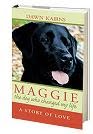
MAGGIE: the dog who changed my life

MAGGIE: the dog who changed my life
Click photo to visit dawnkairns.com

Wednesday, October 16, 2013

FINAL YEARS Stories of Parent Care, Loss and Lives Changed


My second book, FINAL YEARS STORIES OF Parent Care, Loss and Lives Changed is now available on Kindle and Nook. I share this with you in case you are in the shoes of being a caregiver for your parents or know someone else in the caregiver’s shoes. Here is the description: 

“Helping our parents’ transition through aging, decline and death changes many adult children's lives forever. It shakes their very foundation. Caregivers often feel lost and alone and don't know where to turn for support in a culture where sharing feelings about the decline of a loved one, emotional pain and loss may not be well-received. Many tears are cried while making difficult choices with and for loved ones.

In this book ten people share their stories of tough roads of decision-making, family dynamics, grief, and moving on. The author weaves her own account through each of their chapters. While reading these stories in the caregivers’ voice, readers will know they are not alone but part of a "hidden tribe" who share a common bond. They will find guidance for navigating their way through their parents' final years as they find themselves in the stories of others in this book.

This book is for anyone caring for aging parents, for anyone grappling with sibling conflict during this difficult time, for anyone who has lost a parent, and for those with unresolved guilt or regret around their parent's decline and death. It is also for parent elders who wish to look through the eyes of children as the adult caregivers.”

FINAL YEARS Stories of Parent Care, Loss and Lives Changed is currently available on Amazon Kindle, and on Barnes and Noble Nook. I hope you will share this with friends you care about who are dealing with caring for aging or declining parents, or their loss. It will soon be having its' own separate blog.
 

Sunday, September 29, 2013

No Pets Left Behind

"No Pets Left Behind" was the motto of the Colorado National  Guard during the recent September flood rescues in and around Boulder, Colorado. I listened to the drone of helicopters for days overhead as they flew to and from, rescuing people and pets from flood ravaged towns like Lyons and Jamestown. Thank God we learned from Hurricane Katrina! My husband and I went down and volunteered after Katrina with the Humane Society of the United States at a makeshift animal shelter. Sadly, we watched people who had been painfully separated from their pets coming in to search for them. They primarily left disappointed and heart broken. Many pets were re-homed after Katrina rather than reunited with their families.

September 13 Boulder Daily Camera photo
So KUDOS to the Colorado National Guard for realizing that including pets can be the deciding factor for people to choose to leave their homes and be rescued. For recognizing that our pets are our family members. Some helicopters performing rescues carried more pets than people according to a news reports on September 20, 2013 and the Associated Press. Over 800 pets were rescued by helicopter, some even carried by zip line across raging waters. Hundreds more were rescued by ground crews.

As I watched the evacuees come off the helicopters with dogs and cats in their arms, on leashes and in kennels, I choked up at the sight, so happy we learned, so proud of Colorado. This time the Red Cross had water bowls and kennels waiting!

Click title below if you want to order my book(s):

Monday, September 9, 2013

One More Medical Curriculum Stops Using Live Animals

The majority of medical schools in the United States and Canada have moved away from animal use as part of their instruction. Below is a letter from Neal Barnard, M.D., the president of Physicians Committee for Responsible Medicine (PCRM). PCRM has worked very hard to discourage the use of live animals and pushed for more ethical instruction in medical school curriculum.

caged_pig
From PCRM website

"For more than 20 years, the Physicians Committee has pushed the Uniformed Services University of the Health Sciences—the country's only military medical school—to stop using animals to train medical students. On Sept. 3, 2013, the university agreed.

'Live animals are no longer used for training in the undergraduate medical curriculum," confirmed USUHS dean John E. McManigle, M.D., F.A.C.C., F.A.C.P., in an e-mail to John Pippin, M.D., director of academic affairs for the Physicians Committee.

We could not have succeeded without your support!

In the mid-1980s, the university made headlines in announcing plans to shoot beagles in a medical training exercise. A public outcry aborted the experiments. However, the university conducted other experiments on dogs as part of its routine medical curriculum. Medical students contacted PCRM, asking for help. Given their military obligation, they could not refuse to participate nor could they transfer out of the school.

In 1991, at PCRM's request, eleven members of the House Armed Services Committee, including Pat Schroeder on the left and Bob Dornan on the political right, signed onto a letter asking the university to look into alternatives to animal laboratories and to respect students’ choices about participating. But the university refused to budge. Records obtained in 2007 through the federal Freedom of Information Act confirmed three separate live animal laboratories in the curriculum.

In 2008, the Physicians Committee filed a petition with the Department of Defense (DOD) asking for an end to this animal use based on a DOD policy that nonanimal alternatives be used when available. Dr. McManigle's recent e-mail confirms that USUHS joins the vast majority of medical schools in the United States and Canada that have moved away from animal use to ethically and educationally superior human-based instruction.

The Physicians Committee continues to work with the four medical schools that use live animals to help them transition to nonanimal methods: the University of Mississippi, Johns Hopkins University, the University of Tennessee at Chattanooga, and Oregon Health and Science University.

Thank you! Without you, PCRM would not be able to secure victories like this both for animals still used in medical education and for the future patients of today’s doctors in training."

To learn more about the great work of the Physicians Committee for Responsible Medicine or to support their mission of ending unethical animal experimentation in medical schools, please visit their site here.

Click title below if you want to order my book(s):

Sunday, September 1, 2013

Every Time I Lose a Dog ...


It came to me that every time I lose a dog they take a piece of my heart with them,
and every new dog who comes into my life gifts me with a piece of their heart.
If I live long enough all the components of my heart will be dog, 
and I will become as generous and loving as they are.

— ANONYMOUS —

My last post asked you to help the Longmont Humane Society with a donation to avoid foreclosure if you can. Foreclosure could happen by November or December of this year. See post: Longmont Humane Society Facing Possible Foreclosure

To donate checks should be made out to the Longmont Humane Society with "now and forever" written in the memo line and mailed to:

The Longmont Humane Society
9595 Nelson Road
Longmont, CO 80501

Contact: Liz Smokowski at 303-772-1232, ext. 225, or liz@longmonthumane.org or Shelley McLeod at 720-864-2878 or smcleod@longmontchamber.org

Click title below if you want to order my book(s):

Wednesday, August 7, 2013

Longmont Humane Society Facing Possible Foreclosure

The following excerpts are from an article printed in the Longmont Times Call newspaper on July 25, 2013. The Longmont Humane Society is in grave danger of having to close their doors. I am posting the article here to help LHS gain as many donations as possible so they can continue doing their wonderful work for the animals. Longmont Humane has truly championed the cause of pitbull terriers. Thanks to LHS, so many pitbulls that would have faced euthanasia due to breed bans in other cities are instead enjoying their lives with loving families.

Longmont Humane Society makes plea for donations to avoid foreclosure

$772k needed by November for loan payment

By Whitney Bryen Longmont Times-Call

LONGMONT -- The Longmont Humane Society is asking for $772,227 in donations by Nov. 30 to avoid possible foreclosure later this year.

Construction cost overruns from the facility's expansion that began in 2006 and six years of financial deficits have drained the organization's reserves, leaving the humane society unable to make its 2013 and subsequent annual loan payments, executive director Liz Smokowski said.

The nonprofit needs to raise this year's payment within four months or the organization could face foreclosure or be forced to file for bankruptcy as early as December, said Smokowski, who inherited the loan when she was hired at the end of 2011.

In 2006, the town of Lyons, which uses the society's services, issued a bond for $6 million on behalf of the humane society under the state's Municipalities Development Revenue Bond Act to allow the society to begin construction. Wells Fargo now holds the loan.

In 2005, philanthropist Susan Allen of New York had promised the humane society $5 million for the expansion of its facility. That gift came over five years in $1 million increments.
...
The organization's financial problems are due to construction costs for the right away on its expansion. The organization's financial problems are due to construction costs for the 43,000-square-foot expansion and annual deficits from 2006 to 2011 exceeding $1.6 million. The cost of the expansion was forecast to be about $8.2 million but came in at $9 million by the time it opened in January 2009, Smokowski said.

Donations decreased starting in 2007 following the economic downturn, and operating costs increased once the expansion was completed due to higher utility costs and expenses associated with the care of more animals.
...
Currently loan-holder Wells Fargo has refused to renegotiate the loan. More than a dozen other banks have refused the organization's request to take over the loan, mostly due to the deficits, Smokowski said.

Shortly after Smokowski's arrival, the humane society hired an auditor to go over financial statements from 2003, which revealed six consecutive years of deficits.
 ...
The nonprofit has launched a fundraising campaign, The Longmont Humane Society: Serving the Community Now and Forever, focused on large gifts to achieve the organization's immediate and long-term goals, which include paying off the remaining $3.1 million on the loan by the fall of 2014.

...
Read full article here: Times Call

To donate checks should be made out to the Longmont Humane Society with "now and forever" written in the memo line and mailed to:

The Longmont Humane Society
9595 Nelson Road
Longmont, CO 80501

Contact: Liz Smokowski at 303-772-1232, ext. 225, or liz@longmonthumane.org or Shelley McLeod at 720-864-2878 or smcleod@longmontchamber.org

Whitney Bryen can be reached at 303-684-5274 or wbryen@times-call.com.

Friday, May 24, 2013

Decline and Death of a Parent: Stories From Those Who Have Been There

We are moved by what we love. First, it was my dog, my constant companion, Maggie, who inspired my first book, MAGGIE the dog who changed my life. Then caring for my declining parents moved me to write once again, and to talk with others to explore and share their experiences in caring for their aging and dying parents. We all lose our parents. I always knew I'd lose my parents, but was not prepared for how overwhelming and life-changing it was. Perhaps you've been there, too, or are now experiencing this challenging time in your lives.

For those of you who are interested, I describe my book below. I am also asking for your help. I have 3 working titles listed below. Will you please take a moment and respond with a comment on my blog to let me know which one speaks to you the most?  

Coming in 2013 ...

Working Titles:
Decline and Death of a Parent: Stories From Those Who Have Been There

Caring for Aging Parents: Tough Choices, Changed Lives

 Parent Loss: Choices Made, Tears Cried, and Lives Changed

Dad and me around 2000

In my book, I interview others who have lost their parents and share my story, too. We delve into:

  • Family of origin interactions, and relationship with our parents.
  • How the declining health of aging parents impacted us emotionally and in our day to day life.
  • Whether or not siblings worked together to help declining parents. Was there conflict and if so, how did we resolve it?
  • How parent decline and loss changes us and the choices we make in our lives.
  • What decisions we have to make about parent care.
  • Were we at peace with our parents before they became ill; if not, how we made peace with our parents before or after they died. Or not.
  • What happens to family dysfunctional patterns (if present) during parent illness?
  • What coping skills and resources people called on when dealing with declining parents and their eventual deaths.
  • How we who lost parents found support from friends in our grief, or did we?
  • What experiences with health care professionals were like and whether they were helpful or hindering in any way
  • What was clearing out the "stuff" in our parents’ home like?
  • Feelings that were hard to come to terms with surrounding our parents' decline and death; feelings that still haunt us or that we finally came to terms with.
  • Whether any emotions like guilt or anger, or any events interfered with or prolonged our grieving process.
  • How we resolved our grief.
  • How our culture is with grief.
  • Unusual or unexplainable experiences after we lost our parents – what some people might call “paranormal.”
  • Advice for those of you just coming into the care of declining parents or dying parents.
My hope is that this book will help those of you coming into the care of your aging, declining, and dying parents, and that you will find yourself in the stories shared by others in my book. In so doing, may you find comfort, answers, kindred spirits, and support as you go through this unavoidable milestone in your life ...

Please click here and fill out the contact form if you are interested in being on a notification list for when my book on parent aging and loss is available.

Again, I will so appreciate it if you can please take a moment to comment on your preference of title listed above. Thank you very much.

Wednesday, May 15, 2013

Colorado First State to Mandate Training for Law Enforcement Officers in Dog Behavior


Too many innocent dogs have been shot by police officers out of fear and a lack of knowledge on their part of canine behavior.  It has broken the hearts of dog guardians and unnecessarily ended the lives of good dogs.  A petition circulated to sign a bill into law requiring law enforcement officers to be trained in dog behavior and how to handle dog encounters so that innocent dogs are protected and understood rather than shot when barking at an officer.

I just received a notice from the Best Friends Animal Sanctuary Senior Legislative attorney that Colorado Governor Hickenlooper signed the Dog Protection Act bill into law this week, making Colorado the first state to mandate training in dog behavior for law enforcement officers. It will require each local law enforcement agency to provide its officers with training in how to handle encounters with dogs in the course of duty. Their training must cover how to assess a dog’s posture, barking, vocalizations and facial expressions; what options can be used to distract, escape from and safely capture a dog; and what defensive options are available in dealing with a dog.

Thank you, Colorado, for standing up to protect our canines!  And thank you, Governor Hickenlooper!  May the other 49 states soon follow!

Click title below if you want to order my book(s):