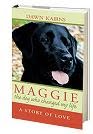
MAGGIE: the dog who changed my life

MAGGIE: the dog who changed my life
Click photo to visit dawnkairns.com

Thursday, May 7, 2015

So Many Dogs, So Little Time

YOU can Recover From the Loss of Your Beloved Canine Companion

Maggie & me days before she died
"'Older dogs that have lived their entire lives with someone are taken to humane societies and rescue groups for reasons as numerous as dog breeds. They have the hardest time being adopted,' Dawn Kairns writes-- in one of the best of all the dog books I've read yet -- in a market full of grieving pet owners immortalizing their pet with a book. This one is filled with insight and wisdom.


'I have this feeling that our special animal friends find their way back to us after they pass on,' Dawn Kairns tells us. Pet owners the world over will believe it, or want to believe it. After losing her beloved canine companion Maggie, Kairns delved into Jung and cited evidence details about Maggie that support this consoling theory: 'The collective unconscious is where we come from, we return to it when we can, and we ultimately return to it when we die.'

"I had just finished reading another dog lover's lament, Mark J. Ascher's "Humphrey Was Here." Interesting contrasts between the two dog owners. Ascher is more of a skeptic. This sounds like me: 'If it was God's will, I wanted to know how he dispersed his tragedies -- an immediate investigation of (God's) distribution system was in order. If I had bad karma, I demanded to know what I had done in another life ... If everything happened for a reason, I wanted to know the reason now, when the pain was intense. I wanted answers; I kept coming up with questions.'

But Kairns offers that spiritual consolation I can only hope-wish-hope for: '...there’s more to this world than what we experience with our limited five senses. Can it be that the spirit world is right here, but most of us lack the extrasensory abilities to perceive it?'

The book opens in a present-tense account of life with Maggie, the dog who is so much more than a pet. Later we get to the "if only I'd known" and "what if" stuff, thoughts we all suffer. One factor contributing to Maggie's untimely demise may have been the thing we believe is best for our pets. My own (former) vet scoffed at me when I pointed out the #1 ingredient in Science Diet is grain. Which one of us got the college degree in veterinary science, he said? Well, call me impudent, but I noticed our dogs fared better when they sneaked out and found fresh venison. No, it never became a staple of their diet, but their droppings clearly showed that fresh venison was easier on their digestive system. Unfortunately, their love of people food and their ability to get it (mastery of the cute, pleading face) also may have led to their pancreative failure at ages 13 and 14. For large Collies, maybe the life expectancy is rarely much better than that. And if you asked Blaise and Bailey, I'm sure they'd have opted for shorter lives than lives without chicken, roast beef, pizza and the occasional cheese puff.

Page after page of this book "speaks" to me as a mother of three and a former companion of two majestic, nearly human Collies. I kept Kindle-sharing lines that had me nodding in agreement or empathy. Rather than retype them here, I'll trust readers to find the page of Kindle Highlights.

I'm skeptical about some of the reincarnation theories but very hopeful that we will indeed meet up again with our lost loved ones, canine, feline, human, equine, or whatever, in a next life. Those who experience the "evidence" are blessed.

This book delivers the happy ending of a new adventure with another dog. So many bereft dog lovers say they'll never get another dog because of the pain of losing one again, or because no dog can replace the one who died. There are so many, many dogs out there, on death row in animal shelters, awaiting adoption. No one with the means to care for a dog has to go dog-less.

My husband is in no hurry to get another dog, but I'm ready for one to turn up, scouring the Rescue sites and local shelter listings, watching and waiting. Meanwhile, I'm one of those strangers who accosts dog owners in public: “I need a dog fix." Mine died. (Or, "We’re here on vacation, and mine is at home.”) Thanks to all of you who indulge me and let me greet your dog.

NOTE: this is one Kindle-Share that bears repeating far and wide --

Maggie loved the switch from dog food to raw
'There are now several brands of high-quality pet foods made with human-grade protein as the first ingredient and without by-products or chemical preservatives. These can be found at smaller holistic pet food stores and include brands such as Canidae, Innova, Natural Balance, and Chicken Soup for the Dog Lovers Soul, among others. Flint River Ranch products can be ordered online.'

Kairns recommends a diet of raw ground turkey, vegetables, grains, and beans, adding vitamin supplements and a nutritional powder of kelp, nutritional yeast, bone meal, and lecithin.

I would add that if your dog has allergies, inform the delivery guys who offer a treat to every dog who greets them. One of our Collies tested allergic to beef, brewer's yeast, and a gazillion other ingredients in dog food and treats."

Posted by Dawn Kairns and taken directly from Carol Kean's Amazon Review. I added the photos. To Carol, my heartfelt thanks. She captures the essence of MAGGIE better than anyone to date in both her above review of MAGGIE and on the Kindle Highlights page:


the ability exists in all of us to intuitively communicate with nature and animals. It’s “the first language, the foundation of spoken and written words, and the common link Read more Kindle Highlights quotes here.

Friday, March 13, 2015

The Simpsons Co-Creator Was an Angel to the Animals

A CARE (Colorado Animal Rescue Express) rescue dog
Did you know that Sam Simon, the co-creator of "The Simpsons" spent millions of dollars each year to save the lives of dogs through his establishment of the Sam Simon Foundation? His non-profit organization for dogs was also created to enrich people's lives.

Simon passed away on March 8, 2015 after a battle with colon cancer that was diagnosed in 2012. After learning of his prognosis of only several months to live, Simon decided give his millions to animal charities and the hungry. Not that he wasn't already spending millions to help animals even before his late stage cancer diagnosis. On  a wonderful piece of real estate in Malibu, his Foundation gave stray and abandoned dogs a new chance at life. In 2007, 60 Minutes called the Sam Simon Foundation “the grandest dog shelter in the country."

Some of the ways Simon has used his millions to help animals and the animal rights cause include:

  • a mobile veterinary clinic that travels throughout Los Angeles to assist low-income folks and their pets.
  • a hearing dog program where the Foundation rescues dogs from shelters and humane societies and trains them to become Certified Hearing Dogs.
  • service dogs for veterans where the foundation trains shelter dogs to assist veterans with PTSD, or trained to help veterans with hearing loss, traumatic brain injury or moderate physical limitations.
  • visitation at assisted living facilities where dogs regularly visit and brighten the days of residents of Los Angeles assisted living facilities.
  • adoption program for shelter and rescue dogs where those rescued dogs who don't quite have what it takes to be service dogs can still make amazing companions. 
Markie, rescued in Texas by my husband and me
Simon has also made large donations to PETA (People for the Ethical Treatment of Animals) and the Sea Shepherd Conservation Society. The latter was able to add a fourth ship to its fleet (since Simon bought it for them), and this ship is now defending whales from Japanese whaling activities in the Southern Ocean Whale Sanctuary.

Simon also created the Feeding Families program in 2011 to respond to families and individuals in economic crisis who are unable to provide food for their children and pets, feeding about 200 families per day. As though all of this is not enough of an amazing legacy, Simon, along with Ingrid Newkirk and PETA began buying zoos and circuses in order to send the animals, those he referred to as "the most abused animals in the country," to a sanctuary.

Thank you, Mr. Simon, for your legacy of love to the animals. And thanks to the Care 2 Causes Blog for the full story on Sam Simon and his wonderful animal philanthropy.

Posted by Dawn Kairns
Author of Maggie the Dog Who Changed My Life

Sunday, February 8, 2015

What Is a Puppy Mill?

I have written about puppy mills before, but because there are still between 2,000 and 3,000 USDA-licensed breeders (or puppy mills) known to be operating in the United States, we still have much work to do to raise awareness to end this horrific treatment of our best friends. This number does not include the breeders who are not required to be licensed by the USDA or the number of illegal puppy mill breeders operating without a license, it's impossible to accurately know how many there truly are. "The ASPCA estimates that there could be as many as 10,000 puppy mills in the United States."

The highest concentration of puppy mills is in the Midwest, with Missouri being the leading puppy mill state. There are also high concentrations of puppy mills in Pennsylvania, Ohio and upstate New York, and parts of Wisconsin. "Commercial dog breeding is very prevalent among Amish and Mennonite farmers."

What Is a Puppy Mill


Although there is no legal definition of a puppy mill, according to the ASPCA, a puppy mill "is a large-scale commercial dog breeding operation where profit is given priority over the well-being of the dogs."

Some puppy mill puppies are sold to pet shops and their lineage records are often falsified. Others are sold directly to the public "over the Internet (many puppies sold online come from puppy mills), through newspaper ads, and at swap meets and flea markets." Because breeding at puppy mills is done with no consideration of genetic quality, generations of dogs are born with hereditary defects which the unsuspecting public "inherits" when they purchase a new puppy through those means mentioned above. A responsible breeders, on the other hand, "places the utmost importance on producing the healthiest puppies possible."

When a pet store owner tells you they get their puppies from "licensed USDA breeders" or "local breeders," it means they get their puppies from puppy mills. A breeder must be licensed by the USDA in order to sell puppies to pet stores, and pet stores often use this licensing to provide a false sense of security to their customers. Responsible breeders want to screen potential buyers to ensure that their puppies will go to good homes, so they would never sell a puppy through a pet store.

Conditions Are Deplorable in Puppy Mills


The conditions most puppy mill dogs are kept in are deplorable. According to the ASPCA, "puppy mills usually house dogs in overcrowded and unsanitary conditions, without adequate veterinary care, food, water and socialization. Puppy mill dogs do not get to experience treats, toys, exercise or basic grooming. To minimize waste cleanup, dogs are often kept in cages with wire flooring that injures their paws and legs—and it is not unusual for cages to be stacked up in columns. Breeding dogs at mills might spend their entire lives outdoors, exposed to the elements, or crammed inside filthy structures where they never get the chance to feel the sun or breathe fresh air." Female dogs are bred with little to no recovery time between litters. After a few years, when they can no longer can reproduce because they are so depleted, they are frequently killed.


Having Papers Means Nothing!


Being "registered" or "having papers" merely means that the puppy's parents both had papers. Many registered dogs are sold in puppy mills. "Many, many pedigreed dogs come from puppy mills! The only way you can be sure that a puppy came from a reputable source is to see where he or she came from yourself."


What You Can Do?

Adopt! Many purebred dogs end up in shelters or rescue groups, so please explore these options before you search for a reputable breeder. If you do buy a dog from a breeder, be sure to meet the puppy's parents or at least the mother. Check out their living conditions. "Never meet a breeder at an off-site location, and never have a puppy shipped to you sight-unseen."

Better yet, adopt a puppy mill survivor. "Puppy mill survivors often need patient, loving adopters who can help them learn to trust people."

Above all, refuse to shop at any store that sells puppies, even if you are only buying food or toys. This is the best way to put puppy mills out of business.

Thank you to the ASPCA for this information. To learn more about puppy mills, the health and behavioral problems found with puppy mill dogs, and what you can do to help this cause, visit their website.

Posted by Dawn Kairns, author of MAGGIE the Dog Who Changed My Life

Friday, January 16, 2015

Dog Rides Bus to Dog Park By Herself


KOMO Channel 4 reported this Seattle story of Eclipse, a black lab/mastiff mix who has seemed to figure out mass transit on her own! Eclipse jumps on the bus by herself and gets off at the dog park when her owner takes too long finishing his cigarette at the bus stop! He catches up with her later. Passengers and bus drivers alike know Eclipse and she makes their day. Enjoy watching this KOMO  news report--I sure did:


Read the full story here: Seattle dog's rush hour ride: on the bus, by herself, weekly

Posted by: Dawn Kairns
Author of MAGGIE the Dog Who Changed My Life

Monday, December 22, 2014

The True Story of Rudolph the Red-Nosed Reindeer

My friend sent this to me a few days ago. I had never heard this before and found it really beautiful and inspiring. Maybe you have never heard it either?

The True Story of Rudolph

A man named Bob May, depressed and brokenhearted, stared out his drafty apartment window into the chilling December night. His 4-year-old daughter Barbara sat on his lap quietly sobbing. Bob's wife, Evelyn, was dying of cancer.

Little Barbara couldn't understand why her mommy could never come home. Barbara looked up into her dad's eyes and asked, "Why isn't Mommy just like everybody else's Mommy?"

Bob's jaw tightened and his eyes welled with tears. Her question brought waves of grief, but also of anger. It had been the story of Bob's life. Life always had to be different for Bob. Small when he was a kid, Bob was often bullied by other boys. He was too little at the time to compete in sports. He was often called names he'd rather not remember.

From childhood, Bob was different and never seemed to fit in. Bob did complete college, married his loving wife and was grateful to get his job as a copywriter at Montgomery Ward during the Great Depression.

Then he was blessed with his little girl. But it was all short-lived. Evelyn's bout with cancer stripped them of all their savings and now Bob and his daughter were forced to live in a two-room apartment in the Chicago slums.

Evelyn died just days before Christmas in 1938. Bob struggled to give hope to his child, for whom he couldn't even afford to buy a Christmas gift. But if he couldn't buy a gift, he was determined to make one - a storybook!

Bob had created an animal character in his own mind and told the animal's story to little Barbara to give her comfort and hope. Again and again Bob told the story, embellishing it more with each telling.

Who was the character? What was the story all about? The story Bob May created was his own autobiography in fable form.

The character he created was a misfit outcast like he was. The name of the character? A little reindeer named Rudolph, with a big shiny nose.

Bob finished the book just in time to give it to his little girl on Christmas Day. But the story doesn't end there.

The general manager of Montgomery Ward caught wind of the little storybook and offered Bob May a nominal fee to purchase the rights to print the book.

Wards went on to print, “Rudolph, the Red-Nosed Reindeer” and distribute it to children visiting Santa Claus in their stores. By 1946 Wards had printed and distributed more than six million copies of Rudolph.

That same year, a major publisher wanted to purchase the rights from Wards to print an updated version of the book. In an unprecedented gesture of kindness, the CEO of Wards returned all rights back to Bob May.

The book became a best seller. Many toy and marketing deals followed and Bob May, now remarried with a growing family, became wealthy from the story he created to comfort his grieving daughter. But the story doesn't end there either.

Bob's brother-in-law, Johnny Marks, made a song adaptation to Rudolph. Though the song was turned down by such popular vocalists as Bing Crosby and Dinah Shore , it was recorded by the singing cowboy, Gene Autry.

"Rudolph, the Red-Nosed Reindeer" was released in 1949 and became a phenomenal success, selling more records than any other Christmas song, with the exception  of "White Christmas."
 
The gift of love that Bob May created for his daughter so long ago kept on returning back to bless him again and again. And Bob May learned the lesson, just like his dear friend Rudolph, that being different isn't so bad. In fact, being different can be a blessing.

Happy Holidays, Everyone!
Dawn Kairns, Author of  Maggie the Dog Who Changed My Life

Tuesday, November 11, 2014

Please Just Give Me a Sign

Bailey Bear
My friend recently lost her beautiful Golden Retreiver, Bailey Bear (BB), to heart failure. Like so many of us, she was not prepared and it was a devastating loss for her. Again like so many of us when we lose a beloved pet, she experienced guilt. In her case it was concern that she and her husband had left BB alone too much when they went away on trips. Now, mind you, Bailey Bear was taken to a popular, upscale Boulder kennel where she received a lot of attention from people and played with other dogs. But that was where my friend's guilt came in. Was BB happier with all the excitement of being with other dogs and people than spending time at home with Patricia and her husband? Of course we know the answer to that! I had been on hikes with Patricia and Bailey Bear. BB adored my friend.

Soon after BB passed, Patricia was running one day and talking to BB's spirit. She asked BB  if she had been happy with how they cared for her during her lifetime. Patricia  asked her to give her some sort of a sign that she had been happy. She kept looking around for signs as she ran - butterflies, birds, etc. When she got back in her car after her run and while driving home, Patricia continued to talk to BB.

Lola
"Now here comes the WOW part." she told me as she recounted her story to me. "As I was walking into the door of my house Rhonda (BB's caregiver from Cottonwood Kennel) sent me a text with a photo that I thought was BB. A couple of minutes later she sent another text to tell me that the photo she sent was of BB's sister. Her name was Lola and it was the first time she had been to Cottonwood! She did some things that reminded Rhonda of BB, so she looked at her information. Lola had the same birthday as Bailey Bear - Valentine's Day 11 years ago! Rhonda confirmed with the owners when they picked her up that she came from the same breeder. I think BB gave me a sign through Lola."

As though BB wasn't convinced that was enough of a sign, Patricia had a most unusual experience with a wild animal -- a marmot -- right on her front door step. She heard a noise and went to explore. There, standing at her front door looking right in the window and scratching on it as if to want in, was a marmot! That just doesn't happen!

"In the 12 years we've lived here, I have NEVER seen a marmot up here," Patricia told me. "Roman (her husband) saw a marmot one time about 3 years ago."

Marmots don't do this!!
I, too, have had out of the ordinary experiences with wild animals after a loved one has passed. Like the bird who grazed my face with its' wing after my parents' passed. You may call it coincidence. But I can't ignore the serendipity of it all. How about you? Do you have your own stories you'd like to share in the comments below about how your pets or other loved ones who have passed have found a way to make their presence known to you from the other side?

Posted by Dawn Kairns, Author of
MAGGIE the Dog Who Changed My Life