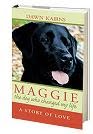

Thanks so much to all of you who have expressed your care and compassion about Cinnamon, my cat, (some of you already know her from my book as Maggie’s buddy)with her recent illness and diagnoses. I’ll share the story here for those of you who want to know.
A year ago, I changed Cinnamon to a grain-free diet to see if a decrease in carbohydrate content would help her lose weight; I decreased the amount of her dry food to ½ cup per day and increased her wet food servings at the recommendation of our vet (I had noticed some bad breath and was concerned re: her teeth. They were fine, but our vet suggested the dry food could contribute to her bad breath).
Cinnamon lost 3 lbs. over the course of this past year on this diet with the decrease of carbohydrate, which I was absolutely delighted over since she was overweight at 14 lbs. for years. She began moving more nimbly, and showing interest in going outside with me again at home. Her bad breath disappeared. I was very happy with the results. My preference would be to feed her a whole food diet, but I tried this with her when I changed Maggie, our dog, years ago. She refused it then and continues to. I had hoped to blog about the wonders of a grain-free diet and how naturally Cinnamon lost weight with it. I still think grain-free food is the way to go with our cats if they won’t eat raw or whole food. But instead, I am writing about a fairly sudden health decline in my beloved feline girl.
In the last couple of months Cinnamon’s water consumption has increased. On the one hand, she was less energetic, which I expected at age 17. On the other, she still had occasional bursts of running spells up and down the hall. She continued to love hanging out on the floor with us as we did our yoga stretches, rubbing against us and purring. She still taunted me by biting my head when I was lying down stretching, inevitably being in the way of me doing my complete stretch. I knew with her age and the increased drinking that kidney disease may become a concern.
 We are currently on our yearly mountain camping trip with our animals. This is the 6th year that Cinnamon, our cat, has gone with us--it’s a time we are all closer than we are at home in our small camper quarters, both physically and emotionally, without the many distractions of daily life at home. She has always seemed to thrive when going with us. On the first leg of our trip, Cinnamon seemed herself for the most part, but the amount of food she was eating declined. The increased drinking continued. I decided it was time to take her to obtain blood lab tests when we arrived in Montrose, CO.
 The news came back over the phone an hour later as a shock. Her blood work showed an increased number of white blood cells, and a very low red cell count. This means Cinnamon is very anemic. According to the Montrose vet, there was no sign of infection in Cinnamon’s urinalysis, no fever. She believes from looking at the white cells on a slide that Cinnamon has leukemia or lymphoma. Needless to say, this is not what I expected to hear. In addition, she does have early kidney disease. The Montrose veterinarian said we could send the slide to pathology for a definitive cancer diagnosis, but she felt pretty certain looking at the slide that Cinnamon had cancer. She also indicated it was just a matter of what killed Cinnamon first. Ridiculously, in my shock and emotional state, I said she didn’t need to send the slide. I liked the vet when I saw her, but I was struck on the phone by the matter-of-fact way she delivered her information, devoid of compassion.
I asked her about changing Cinnamon to a kidney diet and she indicated it might be just as well to leave her on her current diet given the probable leukemia/lymphoma, and difficulty of changing her.
“Is there something we can do to treat her anemia?” I asked.
“Nothing without significant side effects,” said the veterinarian.
I felt hopeless. “What about subcutaneous fluids? Wouldn’t that help her kidneys?”
“You can try that and see if it makes a difference at all,” she said. “You can bring her back in right now and we’ll give them if you like.
 The lack of hope offered, the reluctance to treat, her nonverbal communication all left me with the feeling that Cinnamon days were truly numbered and possibly few. But we jumped in the truck immediately to try the fluids. But rather than the improvement you’d expect from re-hydration in kidney failure, we saw the opposite over the next 36 hours: increased lethargy, withdrawal, no interest in eating (except the moment we returned from the vet), her purring ceased, and Cinnamon just wanted to be left alone. It felt like the life was draining out of her. I was devastated. I even contacted a vet in Ouray, where we are now, to see if he’d come to our camper to euthanize her if it came to that. I didn’t want her to be stressed by going to a vet again in her last moments.
I began wondering if the fluid had done more harm than good given how significant her anemia was. Could even subcutaneous fluids dilute her blood further, in essence temporarily decreasing her red blood count further? I consulted with Cinnamon’s veterinarian in Boulder whose opinion I value greatly (we had the blood work sent to him). When he told me that we really had to be careful with giving her fluids given her anemia, it validated what I felt about the fluids (although the Ouray vet disagrees). He offered me hope, although not false hope with his uncertainty about Cinnamon’s leukemia/lymphoma diagnosis, saying that he would expect to see a higher white count than she was exhibiting. He also assured me that her renal failure was early and not likely the cause of her anemia (the kidneys make erythropoiten, the precursor to red blood cells. In more advanced kidney disease this hormone ceases to be made by the kidneys). He said they often gave vitamin B12 injections to older cats since they can develop in an anemia from lack of this vitamin, just as older humans can. He also suggested giving her ¼ tablet of Pepcid daily because kidney dysfunction can also decrease the stomach hormone gastrin, causing an increase in stomach acid leading to decreased desire for food.
Hope! A direction! After asking the Montrose vet to prescribe B 12 injections, my husband, Tom, drove back to Montrose to get the B 12 so I could give it to Cinnamon in the camper without moving her. Cinnamon gradually improved over the next few days (which I attribute to being further away from receiving fluids and perhaps to the Pepcid—the B 12 can take a week or so, I understand). I also found a chewable multi-vitamin with iron that may also help her anemia.
My heart leapt with joy when Cinnamon jumped down from the camper bed and walked over to Maddie’s bed to cuddle with her, licking Maddie’s head with a fury, the way she’s always done. She became more interactive with us again, and her purr returned. Her appetite seemed to return somewhat, but is variable. Yet her overall energy has changed, diminished from only a couple weeks ago. I know our time together is numbered, and for now I’m grateful we do not have to say our final good-bye yet. At times she seems so frail – at other moments she’s more herself. At night in our camper she lies next to my head and purrs.

“Your purr is music to my ears, my little Buddha,” I tell her. I pray I can hear her song for some years yet, knowing it may only be a matter of weeks or days, unless we can get her anemia turned around.
Photos: Top left, Cinnamon in South Padre Island, 2-8-2010
2nd from top on right, outside camper door in Lake City, 7-10-2010
3rd from top on left, in camper on sleeping bag, 7-8-2010
Bottom center, in camper on my sleeping bag, 7-8-2010
Thank you all for your suggestions, offers of information, for caring.
Posted By:
Dawn Kairns
Author of MAGGIE the dog who changed my life

Twitter: themaggiebook

