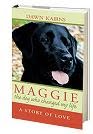
MAGGIE: the dog who changed my life

MAGGIE: the dog who changed my life
Click photo to visit dawnkairns.com
Showing posts with label American Veterinary Medical Association. Show all posts

Monday, January 16, 2012

Owning a Pet is a Privilege and More Says American Veterinary Medical Association

Thanks to Nancy Kay, DVM, Author of Speaking for Spot and her newsletter, I just became aware that the Executive Board of the American Veterinary Medical Association (AVMA) recently approved the following guidelines for responsible pet ownership, approved this past November, 2011. I love hearing words like "privilege" and "commitment for life" associated with pet ownership/guardianship!

Does this qualify for proper exercise?

Guidelines for Responsible Pet Ownership
Owning a pet is a privilege and should result in a mutually beneficial relationship. However, the benefits of pet ownership come with obligations. Responsible pet ownership includes:
  •  Committing to the relationship for the life of the pet(s). 
  • Avoiding impulsive decisions about obtaining pet(s), and carefully selecting pet(s) suited to your home and lifestyle.
  •  Recognizing that ownership of pet(s) requires an investment of time and money.
  •  Keeping only the type and number of pets for which an appropriate and safe environment can be provided, including appropriate food, water, shelter, health care and companionship.
  • Ensuring pets are properly identified (i.e., tags, microchips, or tattoos) and that registration information in associated databases is kept up-to-date
  • Adherence to local ordinances, including licensing and leash requirements.
  • Controlling pet(s)' reproduction through managed breeding, containment, or spay/neuter thereby helping to address animal control and overpopulation problems.
  • Establishing and maintaining a veterinarian-client-patient relationship.
  • Providing preventive (e.g., vaccinations, parasite control) and therapeutic health care for the life of pet(s) in consultation with, and as recommended by, its veterinarian.
  • Socialization and appropriate training for pet(s), which facilitates their well-being and the well-being of other animals and people.
  • Preventing pet(s) from negatively impacting other people, animals and the environment, including proper waste disposal, noise control, and not allowing pet(s) to stray or become feral.
  • Providing exercise and mental stimulation appropriate to the pet(s)' age, breed, and health status.
  • Advance preparation to ensure the pet(s)' well-being in the case of an emergency or disaster, including assembling an evacuation kit.
  • Making alternative arrangements if caring for the pet is no longer possible.
  • Recognizing declines in the pet(s)' quality of life and making decisions in consultation with a veterinarian regarding appropriate end-of-life care (e.g., palliative care, hospice, euthanasia).
Would that all pet guardians provide mental stimulation, socialization, training, exercise, proper health care, spay and neuter and more for their beloved treasures, the animals they are entrusted with... Thanks, AVMA!

Posted By Dawn Kairns, Author of MAGGIE: the dog who changed my life

Saturday, May 29, 2010

Seat Belts for Dogs Can Save Their Lives, Too

Dogs like car rides, but take care that Fido doesn’t go flying
By John Davidson
From DenverPost.com Blog Fetch

My family was riding down a familiar street one day years ago and our dog, Rex, was hanging his head out an open window like Casey Jones at the throttle of a railroad engine.

Then in a flash, it happened. Rex spotted another dog across the street and leaped from the window – into the side of an oncoming car. In a horrible instant, he fell beneath the wheels and rolled several times before the other car could stop.

He lay there on the street, not moving. We were sure he was dead.

Then, to our amazement. he stood up and shook himself off, wagging his tail. We took him to a veterinarian, who could find nothing seriously wrong. But Rex was never quite right in the head after that. He’d stand on the front porch, barking at the wind for hours.

I was reminded of Rex the other day when when I saw a driver travelling down a busy Denver street with his dog in his lap. The hound was hanging its head out an open window and, I swear, grinning for all he was worth. If the driver only knew the dangers that lurked, I thought.

A recent New York Times blog by by Tara Parker-Pope spelled out just how dangerous it can be having pets in the car.

Although driving while text messaging or talking on the phone is getting a lot of attention, Parker-Pope wrote, pets can also be a common source of driver distraction.

Exact statistics on pet distraction are difficult to come by, she noted — most surveys list unrestrained cats and dogs inside the car as one of many “internal distractions” along with grabbing loose items on the seat or swatting an insect.

But nearly 90 percent of pet owners say they travel with their pets. And one survey from Nationwide Mutual Insurance found that 8 percent of drivers admit to driving with a pet on their lap.

A flying dog or cat represents a serious hazard to everyone in the car, Parker-Pope said. The pet advocacy group Bark Buckle UP notes that in a 35-mile-per-hour accident, an unrestrained 60-pound dog would carry the force of a 2,700-pound projectile. Unrestrained dogs and cats can impede rescue workers in more serious accidents, and they also are more likely to be harmed or even thrown from a vehicle in minor fender benders.

For dogs, The Humane Society of the United States suggests a restraining harness that can be purchased from a pet store. The Society also advises keeping a dog in the back seat because front-seat air bags pose a hazard to even large canines.

Because cats are typically uncomfortable riding in a car or being restrained, it’s best to keep them in a pet carrier that is also strapped in with a seat belt, Parker-Pope said.

Mg dogs are pretty typical when it comes to going for a ride. They love it, especially my black Labrador, Heemeyer. He sits in the front passenger seat – obviously not a good idea, since a sudden stop could send him flying into the front windshield.

When I get out of the car he moves to the driver’s seat, behind the steering wheel. He once managed to honk at me when I took too long in a dry cleaning shop. The owner thought it was hilarious.

So what is it about dogs and car rides, anyway?. Another spin through cyberspace came up with this from Vetinfo.com:

+ The car presents familiar smells and sounds. Usually there’s a spot in the car that the dog has made his or her “own place”.

+ It’s a mobile “den”; the enclosed shape provides a sense of security.

+ He can be “on-watch” for his “Master”. Dogs like to have a duty to perform, something to protect.

+ Changing scenery always gives him something new to look at.

+ The dog knows that you (the head of the pack) will come back, as he remembers you always return to the car.

+ The dog knows and feels like he is, physically, part of that pack when contained in the car. Dogs are pack-oriented and you, as the master, are the dog’s focus..

Maybe so, but I’m still not letting Heemeyer drive.

Posted By:

Dawn Kairns  
Author of MAGGIE the dog who changed my life

Website: www.dawnkairns.com